Dativ i lokativ
Dajem Ani kahvu marks Ana with the to form Ani while coffee stays in the want-it form as the gift.
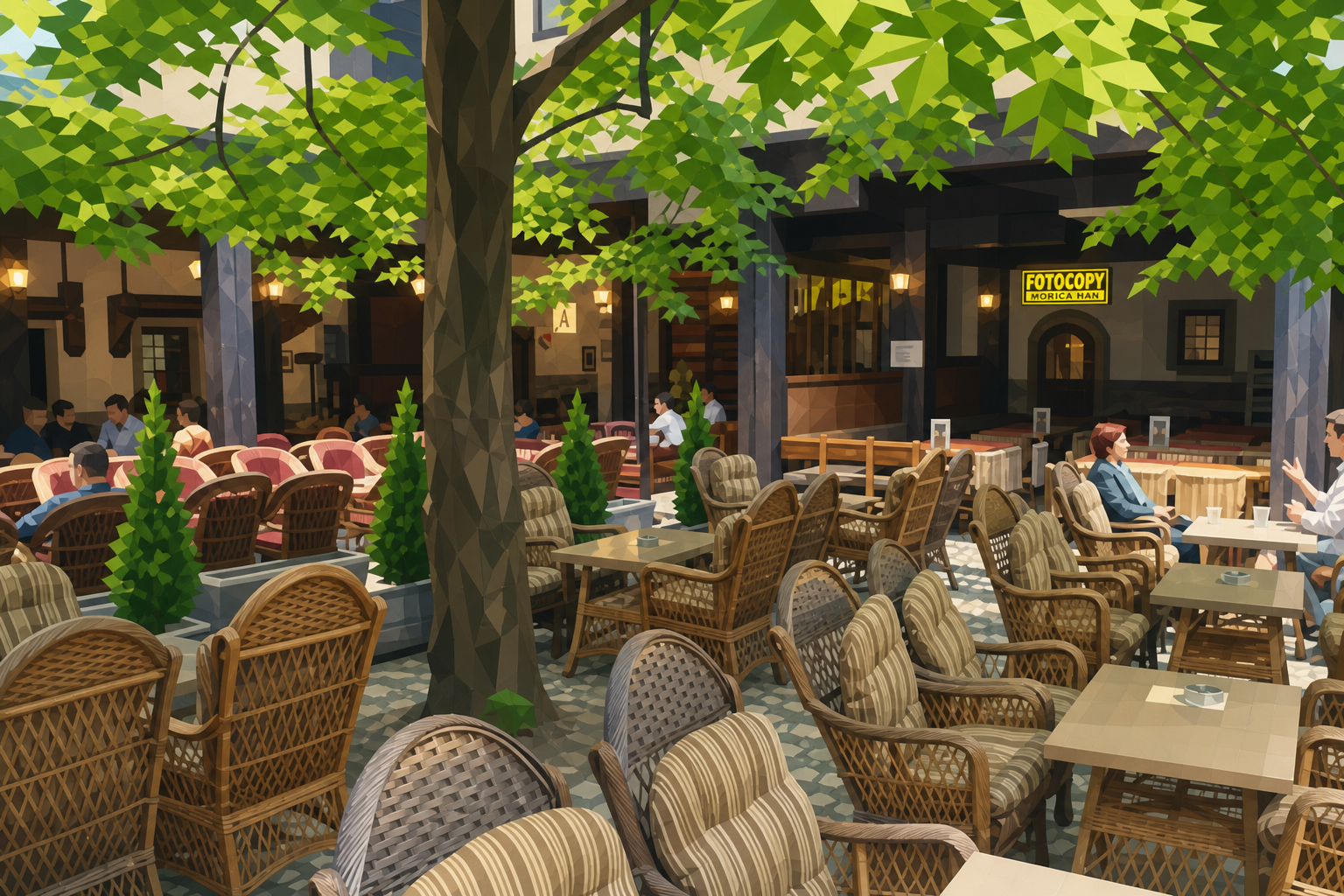
G.4aMorića Han courtyard café, Sarajevo
Why you are here
Today you learn the to, at, and about job on the same coffee and house. Emir can give coffee to Ana, and Ana can already sit in Sarajevo. English hangs to and in in front. Bosnian hangs the job on the end, and it uses one shared outfit for giving to someone and being at a place. You also learn why into the house and in the house are not the same ending.
Why English lies
English lies because the lines I give coffee to Ana and I am in the house keep Ana and house still. Little words do the work. Bosnian dresses the person you give to and the place you sit in. Ana becomes Ani, and kuća becomes kući. Schools split the labels into dativ for to and lokativ for at and about. On these words the ending is usually the same, so you can learn one chart and two English jobs.
A line you already say
Book 1 already parked you in the city with U Sarajevu, which means in Sarajevo. That u on Sarajevu is today’s at job on a leftover place-word. The new twin is giving. Emir says Dajem Ani kahvu, which means I give Ana coffee. Ani is to Ana. Kahvu is still the want-it form from Chapter 2 for the thing being handed over. Two jobs can sit in one short line.
The pattern
She-pile words swap that final a for i in the to, at, and about job. Kahva becomes kahvi, kuća becomes kući, and Ana becomes Ani. He-pile words usually take u, so most becomes mostu and Emir becomes Emiru. Leftover-pile words usually take u too, so pivo becomes pivu and Sarajevo becomes Sarajevu. Use that form when you give to someone, when liking uses a to-me scrap like mi, when you are in or on a place, and when you talk about a thing. Keep the want-it form for motion into a place.
| Pile | List form | To / at / about |
|---|---|---|
| she (ona) | kahva, kuća, Ana | kahvi, kući, Ani |
| he (on) | most, Emir | mostu, Emiru |
| leftover (ono) | pivo, Sarajevo | pivu, Sarajevu |
Ja sam u kući uses the at form, while Idem u kuću keeps into on the want-it ending.
The pests
The big pest is in versus into. Ja sam u kući means I am in the house, with today’s at form. Idem u kuću means I go into the house, with the want-it form from Chapter 2. The little word u stays the same while the house ending shows the job. The second pest is giving to Ana while leaving her as Ana. Dajem Ana kahvu is English word order with a Bosnian costume. She needs the to form Ani. The third pest is thinking to and at need two different endings on these words. They usually share one outfit.
The bit that tricks you
The trap is to hear u and always reach for one ending. U is not the job. The job sits on the next word. Motion into a place wants the want-it form. Being in or at a place wants today’s form. The other trap is to mark the gift and forget the person. In Dajem Ani kahvu, Ani is to Ana, and kahvu is the coffee being given. If you only change coffee, you still missed the to job.
| English job | Form | What changed |
|---|---|---|
| We are in Sarajevo. | Sarajevu | at, leftover takes u |
| I give Ana coffee. | Ani | to Ana, she takes i |
| I am in the house. | kući | at, she takes i |
| I go into the house. | kuću | into, want-it from Chapter 2 |

U Sarajevu is the at form Book 1 already used for being in the city.
Sample words
Tap a word to hear it.
Look at these
Each line has a speaker. Tap the line to hear it. On some lines you can record yourself for a short Speak Check.
Speak Check listens to your recording and sends back short tips.
Speak Check listens to your recording and sends back short tips.
Speak Check listens to your recording and sends back short tips.
Try these
Emir gives coffee to Ana. Which form of Ana?
You are in the house. Which form?
You go into the house. Which form?
We are in Sarajevo. Which form?
Amira gives beer to Emir. Which form of Emir?
Talking about coffee. Which form after o?
Standing on the bridge. Which form after na?
Someone says Dajem Ana kahvu. What went wrong?
Why do u kući and u kuću differ?
Do to and at need two different endings on Ana and kuća today?
Quick check
1. Sviđa mi se Sarajevo. What is mi doing?
2. Dajem Ani kahvu. What is Ani?
3. Ja sam u kući versus Idem u kuću. What changed?
4. Why does U Sarajevu look right in Book 1?
5. Pričam o kahvi uses which job?
6. What comes next?
Next
You now know why Ani and kući share an outfit for to and at, and why into still borrows the want-it form. U Sarajevu and Dajem Ani kahvu are the same family. Chapter 5 adds with and calling, then hangs one preposition map for the whole job set. You still will not drown in a naked seven-row dump.
